I look into open-source AI tools on GitHub that can assist me with different cybersecurity activities. Here are some of them that I came across.
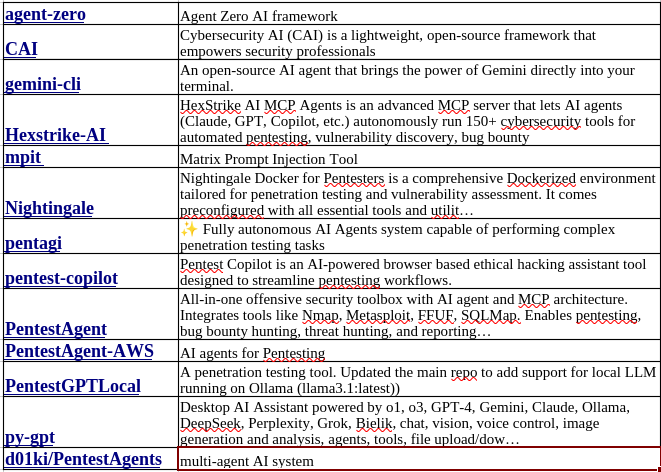
Some of the tools I came across before narrowing the field.
AI Pentest Tool Examples
I am particularly interested in user-friendliness, features, functionality, and modularity. The pros and cons of each tool depend largely on your specific use case. For me, versatility is key, as I intend to use these tools for CTF challenges, bug bounty programs, and penetration testing.
After exploring several options, I narrowed it down to CAI and PentAGI as my two finalists.
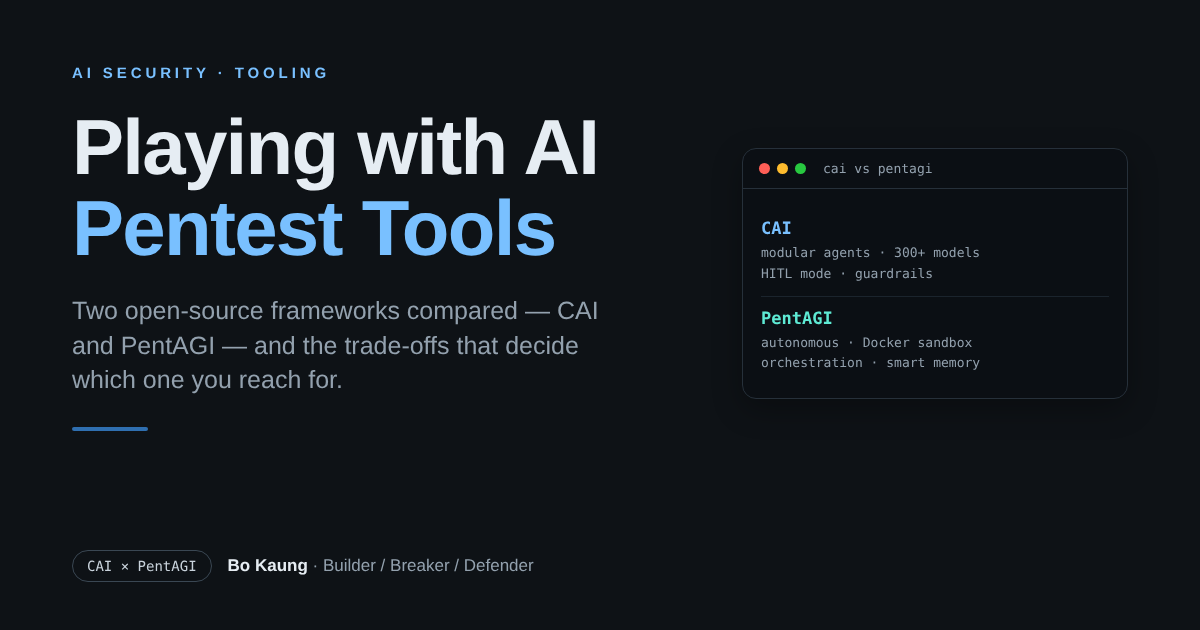
In my opinion, CAI is more user-friendly and easier to set up, making it ready for use immediately after installation. It is an excellent option for various cybersecurity missions with minimal configuration.
PentAGI, on the other hand, is a more powerful tool with a broader range of features. While I appreciate its capabilities, the setup process is more complex, requiring multiple containers and orchestration. Proper configuration is crucial to ensure PentAGI functions as intended. Once configured correctly, it performs exceptionally well.
Key takeaways
PentAGI
- PentAGI is described as a fully autonomous AI-agent system for penetration testing. According to its GitHub repo, it runs in a sandboxed Docker environment, uses a suite of professional pentesting tools (nmap, Metasploit, sqlmap, and others), and can automatically plan and execute testing steps.
- It has a “smart memory system” to store past results and “web-intelligence” capabilities: a built-in browser/scraper plus external search integration to gather intelligence.
- PentAGI is mostly positioned as a tool for “security researchers, ethical hackers, and enthusiasts.”
Cybersecurity AI (CAI)
- CAI is an open-source AI framework for “Cybersecurity AI.” You can build modular, agent-based workflows for tasks like reconnaissance, vulnerability discovery, exploitation, privilege escalation, lateral movement, and reporting.
- It supports many AI models — 300+, including options like Ollama — which gives flexibility depending on your setup or preferences.
- CAI has built-in guardrails (to control dangerous commands or prompt injection), logging and tracing, and a “human-in-the-loop (HITL)” mode — meaning you can pause or intervene in execution, which is safer when testing real or sensitive assets.
- CAI has already been evaluated academically: in one paper it claims to solve CTF challenges and real-world security tasks with significant efficiency gains over human testers (in certain categories).
Originally published on LinkedIn, December 5, 2025.