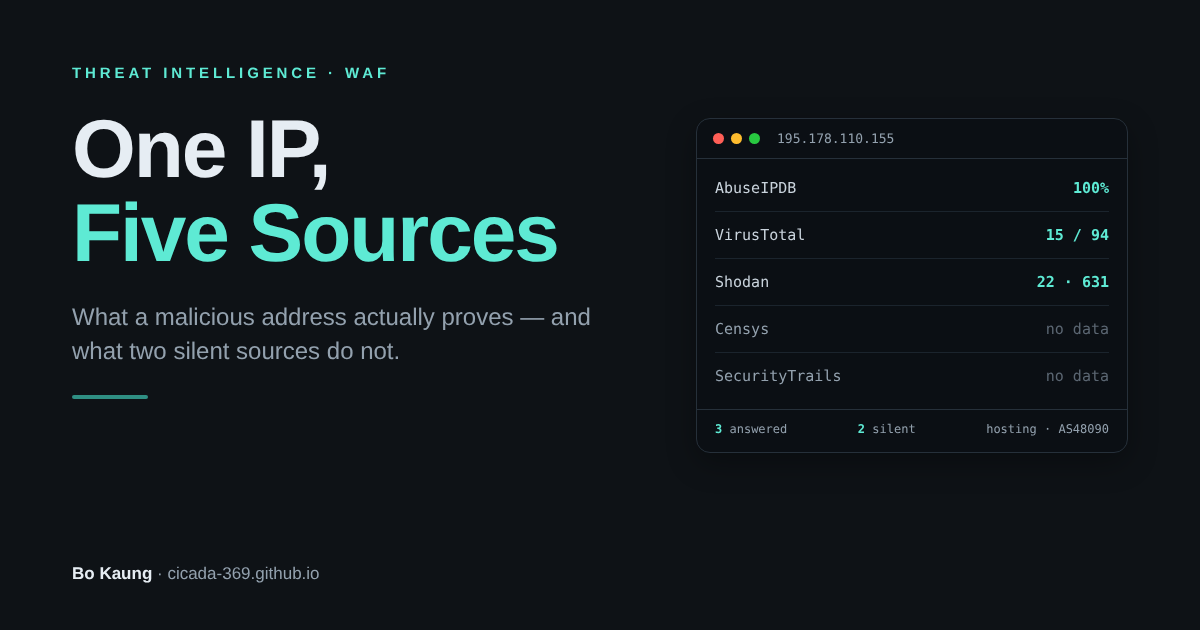
I used to own a WAF block list in AWS. The rules were simple: an allow list, a block list, and a queue of addresses that belonged in one or the other. The hard part was never the rule syntax. It was the sentence before the rule: is this address worth blocking?
That sentence needs evidence. For a while I gathered it by hand — whois,
dig, three browser tabs of reputation pages — until I automated the
repetitive part into IP-Tracer, a shell script that runs the passive checks and
the reputation APIs and writes a timestamped report. This is one run against a
real address, and the verdict I would take to a change review.
The claim and the verdict
The address is 195.178.110.155.
AbuseIPDB gives it a 100%
abuse confidence score. That number is not the interesting part. The
interesting part is what it supports.
| Claim | 195.178.110.155 belongs on the WAF block list |
| Verdict | Block the /32 |
| Confidence | High that it is reported malicious and actively abusive; low on attribution and intent |
| Evidence for | 100% AbuseIPDB confidence; 6,987 reports all-time, 1,370 in 30 days; 15/94 VirusTotal engines on the root URL; 23/149 blacklist listings; reports minutes old |
| Evidence against | Hosting IP; no named incident report; two of five sources returned nothing; geolocation disagrees across four cities |
| What would change it | A whitelist entry, a new tenant, or our own WAF logs showing no malicious traffic |
| What it does not prove | Who is behind it, what they intended, or whether the address is malicious at this second |
What I ran, and what I refused to run
Passive sources only: WHOIS and RDAP, reverse DNS, geolocation, five threat-intelligence APIs, and OSINT. I did not ping, traceroute, or port-scan the address. A public abuse report is not authorization to probe someone else’s host.
IP-Tracer now has a --passive flag for exactly this. It skips the active
sections and writes the reason into the report:
Skipped in passive mode: active connectivity test not run
Skipped in passive mode: traceroute not run
Skipped in passive mode: nmap not run
Everything below came from passive sources or from what other people had already observed.
Ownership: what kind of host is this?
WHOIS and RIPE RDAP agree on the basics:
inetnum:      195.178.110.0 - 195.178.110.255
netname:      TECHOFF_SRV_LIMITED
organisation: ORG-TSL73-RIPE
origin:       AS48090
country:      AD
status:       ASSIGNED PA
created:      2025-01-13
mnt-by:       MNT-NETERRA
Reverse DNS returns nothing. The published abuse contact is a free-mail address rather than a provider role address.
None of that is a verdict. It tells me what kind of host this is: a hosting
allocation, not a residential connection, not a CDN edge, and not a Tor exit —
AbuseIPDB records isTor: false. Hosting matters because the address is one
tenant among many, and the provider, not the tenant, controls the range. It is
also why “block the /32, do not block the /24” is the only responsible
default.
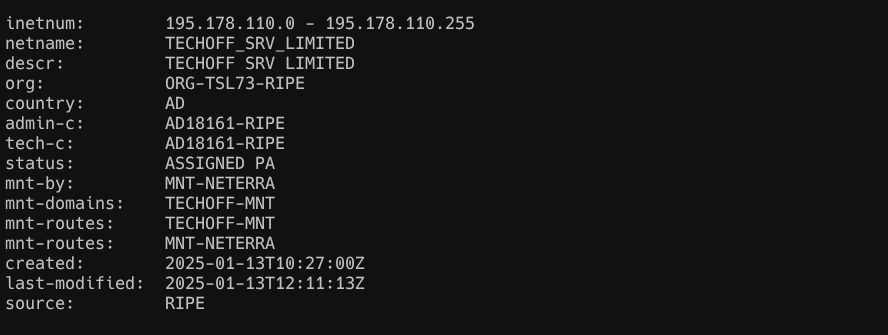
WHOIS/RDAP: a hosting allocation, AS48090, created in January 2025. Reverse DNS is empty. Data as of 2026-10-31.
Reputation: many people watching the same address
AbuseIPDB is the loudest source. On the public page it reported 6,987 reports
from 1,189 distinct reporters, first seen in September 2025, with the most
recent report minutes before I looked. The API the tool calls uses its 30-day
default and returned 1,370 reports from 411 users; the last report was
stamped 2026-10-31T18:00:25Z. Those are the same address at two different
windows, not two different stories. Every number needs its window.
The categories are consistent with a host that scans and probes rather than one
that hosts a popular service: web app attack, bad web bot, brute force,
hacking, port scan. Reporters included WAF and CrowdSec users quoting request
paths such as /wp-json, /telescope, and /forgot-password.
Third-party blacklist aggregators put the address in 23 of 149 lists, including Spamhaus DROP, FireHOL levels 1–4, ET, and DShield. CleanTalk records spam activity against 29 sites, first seen 18 September 2025. None of these are fully independent — blocklists share feeds — but the report is not an AbuseIPDB artifact.
VirusTotal is
quieter but specific. It recorded 15 detections out of 94 engines for http://195.178.110.155/ and https://195.178.110.155/, with
scans on 19 and 25 October. Those detections are on the bare IP root. URLs on
the historical hostname am91cm5leq.fubohd.com were undetected, and the
referrer samples were clean. The engines are flagging the address, not
everything it has ever served.
Shodan draws a different picture: Lelystad, Netherlands; open ports 22 and 631; no hostnames; no vulnerabilities listed. VirusTotal observed HTTP and HTTPS. Both can be true at different times. Shodan is a snapshot, not a live scan, and a missing port is not a closed port.
Two sources said nothing. Censys returned a response the tool could not parse, and SecurityTrails returned no usable data. The report prints a heading and stops. I would rather see the error than a blank section, but a blank section is still a finding: not every clean-looking gap is a clean result.
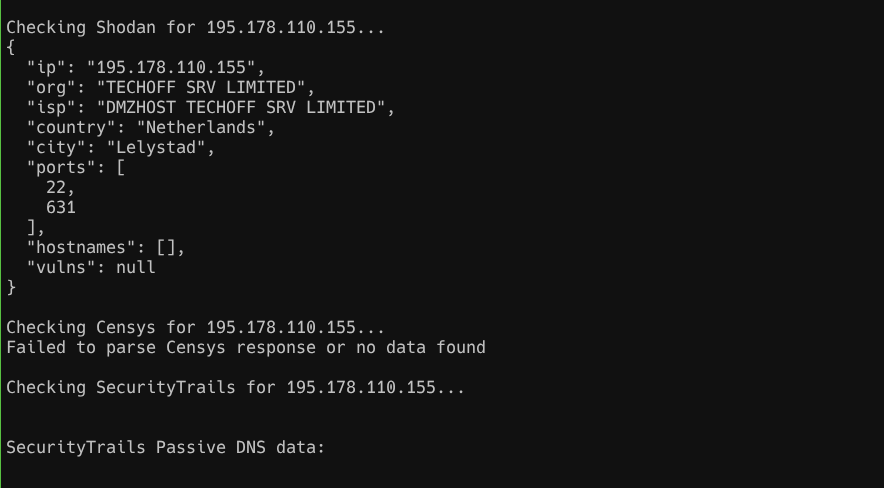
Three sources, two silences: Shodan sees SSH and IPP; Censys and SecurityTrails return nothing usable. Data as of 2026-10-31.
Where the sources disagree
Geolocation is the clearest disagreement. The same address is placed in four cities and three countries:
| Source | Location |
|---|---|
| AbuseIPDB | Amsterdam, Netherlands |
| ipinfo.io | Amstelveen, Netherlands |
| Shodan | Lelystad, Netherlands |
| ip-api.com | Andorra la Vella, Andorra |
| RIPE registry | Andorra |
| VirusTotal | Bulgaria |
| CleanTalk | Bulgaria |
For a hosting address, this is normal and largely uninteresting: the provider’s registration, the datacenter, and the tenant’s routing can all be different, and geolocation services infer rather than observe. It matters only when someone treats a map pin as evidence.
The exposure disagreement is more useful. Shodan sees SSH and IPP; VirusTotal sees a web root that engines dislike. Neither is a live scan. The lesson is not that one source is wrong. It is that each source answers a different question at a different time.
Reputation has the same shape. AbuseIPDB is behavioral and loud. VirusTotal is engine consensus and narrow. Censys and SecurityTrails are silent. A verdict built on one of these is a verdict built on one angle.
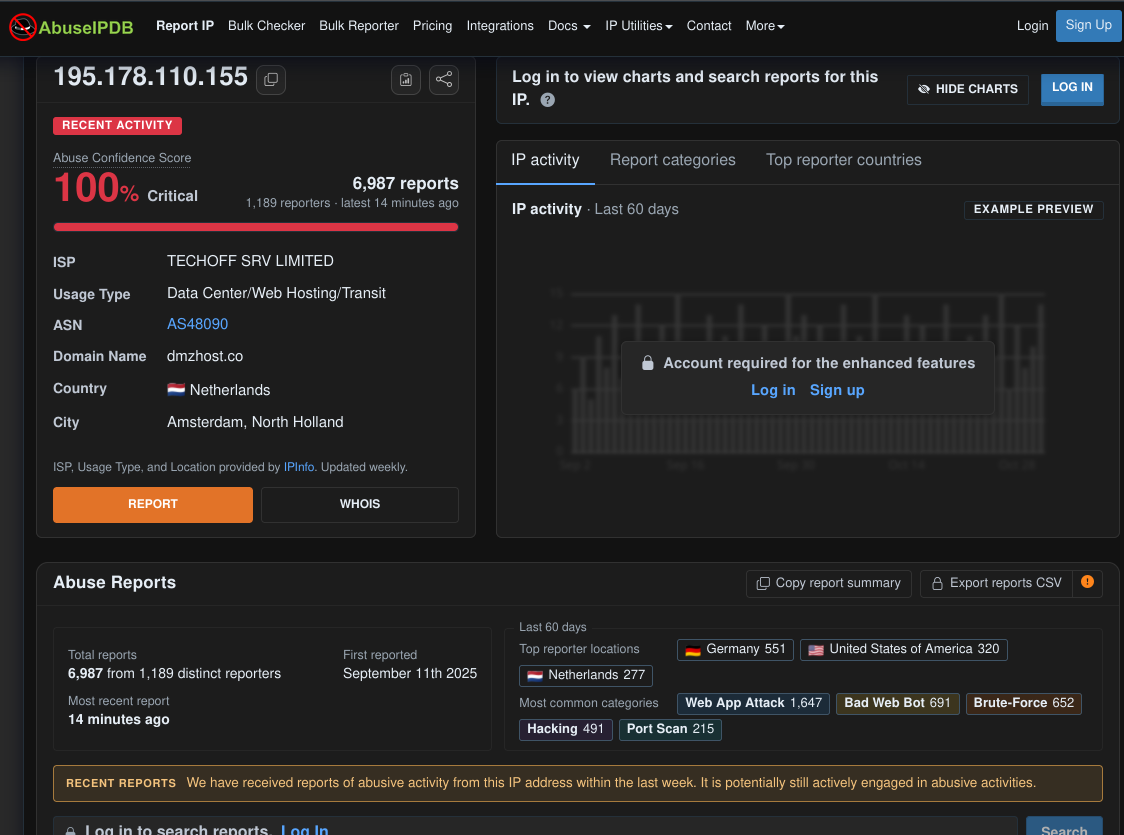
The score is the headline; the reporter count and categories are the evidence. Data as of 2026-10-31.
No vendor research post names this address. That absence is itself a finding: this is commodity abuse with a long public record, not a documented campaign.
The verdict, restated
Block the /32.
The confidence is high for “reported malicious and actively abusive,” because the reports are numerous, independent, recent, and behavioral. It is low for “this specific person or group is attacking you,” because an IP address is not an identity, and reputation data cannot tell intent.
Three qualifications belong in the ticket:
- Do not block the
/24. The range belongs to a hosting provider; co-tenants have done nothing. - Give the rule an expiry. Reputation lags, tenants change, and a permanent block based on a snapshot is a permanent guess.
- Prefer the logs you already have. In production, the WAF logs are the evidence that the address touched you. IP-Tracer tells you what the internet says about the address; it cannot tell you whether that address is in your traffic.
Concretely, I would scope the rule to the address, record the source and capture time in the change ticket, and put a review date on it. If the address reappears, that is a new data point. If the provider reassigns it, the rule is stale and should go.
What this does not prove
- Attribution. An address is not a person, a company, or a campaign.
- Intent. Scanning can be research, a bot, a compromised host, or a probe before an attack. The reports describe behavior, not motive.
- Current state. Reputation data lags and clusters. A report from minutes ago is strong; a report from last month is history.
- Completeness. Two of five sources returned nothing, and one of the three that answered saw the host at a different time than another.
- Sufficiency. A block is containment, not remediation. It does not patch the application, rotate a credential, or evict an intruder.
How this fits the workflow
In production the IP report never stood alone. It joined WAF logs, other intelligence, and an Amazon Q analysis agent that drafted the summary; a human still made the rule change. The script’s job was to make the first five minutes of that review cheap: one command, one timestamped report, and a clear record of what was not checked.
I keep it in Bash because it is light, portable, and fast: no runtime, nothing to install beyond the tools already on a responder’s machine, and the output is a text file that can be attached to a ticket. The trade-off is that Bash is poor at structured data, which is why the report is evidence for a human, not an input to an automated blocker.
That is also why the report keeps its failures. A skipped section, an unparsed response, and a disagreement between sources are not noise to be hidden. They are the boundary of the claim.
Try it
IP-Tracer is at github.com/cicada-369/IP-Tracer. If you run it against this address and a source I marked silent answers for you, I want to know — especially if your evidence disagrees with mine.
Data checked 2026-10-31. Reputation changes; re-check before acting.